
Clarendon Busted Booking Photos
The Clarendon County Detention Center, or CCDC, holds people before trial. It also serves local sentences. Booking follows a set routine. Staff check the arrest paperwork and search the person. They log property and money, then record identifying details. Fingerprints come next. Then the photograph. So an intake photo and booking file almost always exist in county records somewhere. Existing is one thing. Being posted online is another. CCDC's public pages offer no person-by-person roster, no photo gallery, and no dated arrest list.
That gap trips up people hunting for Clarendon County busted mugshots. A photo can sit inside a closed record while the web shows nothing. Someone arrested here may have been released, moved to another agency, or picked up on another authority's warrant. Charges often shift later too. They can be reduced, dismissed, or resolved in court.
Clarendon Booking Record Details
Name the exact record you want. That single step makes or breaks a request. CCDC publishes no field list for its booking material, so the table splits what detention paperwork actually establishes from what you must ask about or verify through the court. A good request includes a full name, a rough arrest or booking date, and the arresting agency if you know it. Also keep your asks straight: a booking sheet is not an incident report, and neither one is the photograph itself.
| Record point | What the local material supports |
|---|---|
| Identity and intake | CCDC collects identifying information, fingerprints, and an intake photograph. |
| Booking date or identifier | No public online number search is posted. Ask for the applicable date range and record number, if one exists. |
| Charges and warrants | Charging paperwork is reviewed, but no county booking-charge feed is public. Confirm a filed matter in court. |
| Bond and hearings | Qualifying bond hearings are scheduled by rotating magistrates. A schedule is not a promise of bond or release. |
| Release and disposition | CCDC can address current local status; the court record carries a case through its eventual disposition. |
Booking is the intake process that follows an arrest. Bond is a court-authorized condition that may allow release. A disposition is the eventual outcome of the case. Each stage generates its own paperwork, so never read one record as a shortcut to another.
Clarendon Busted Record Requests
The sheriff's office runs the most specific published channel for reports, booking records, and photographs that might be released. Clarendon County Sheriff's Office sends FOIA requests to its Office of General Counsel. CCDC separately lists an Administrative Services, Records, and Commissary contact of its own. Calling about who is in custody right now can help. But a phone chat is not a records request. Staff have no obligation to read a full file over the line.
- State the person's full name and the approximate arrest or booking date.
- Name the record wanted, such as a booking sheet, incident report, release record, or photograph if releasable.
- Give the arresting agency, case number, or other known identifier and ask for any required estimate or redaction basis.
- Send the request to the appropriate custodian and retain the response, estimate, and any correspondence.
Costs are spelled out. CCSO charges $20 per hour for general staff time. Pages cost 30 cents each. A CD or DVD holding audio, video, or photos runs $5. A 25 percent deposit on the estimated cost may be required. Timing follows South Carolina FOIA. That means 10 business days for a determination, or 20 days when the records are more than 24 months old, plus whatever production period the statute allows once access is granted. These are process rules only. They guarantee nothing about what gets released. The sheriff's own instructions are on the CCSO Freedom of Information page.
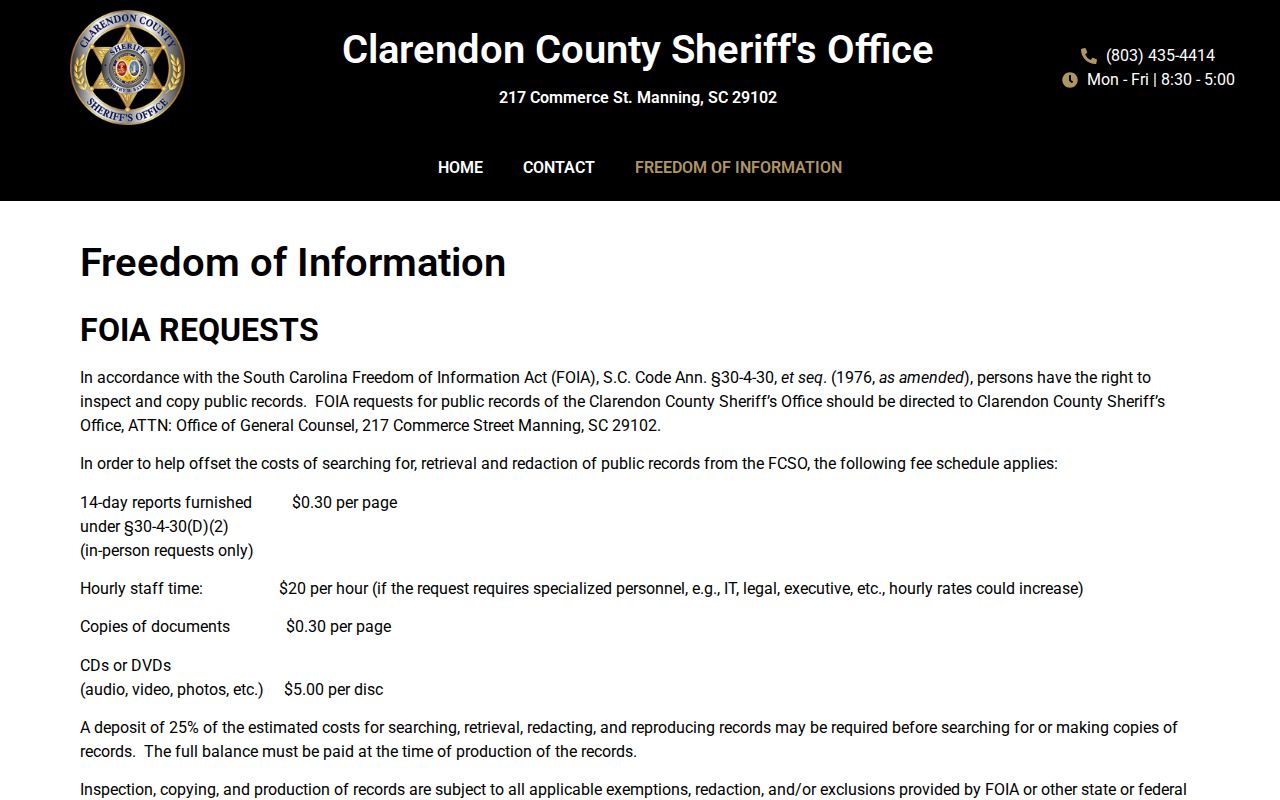
With no public Clarendon booking database to search, the sheriff's official request material offers the clearest path to an actual record.
South Carolina Mugshot Record Rules
South Carolina's FOIA sits in Title 30 Chapter 4. It sets up a general right to inspect and copy records while still allowing lawful redaction or withholding of protected law-enforcement material. So a request might return a redacted record. It might bring a denial with a stated legal basis. It could also mean a cost estimate before any work starts. Nothing in the law converts an internal booking photo into a public web image. Juvenile, sealed, expunged, and otherwise protected material simply may not show up in public systems.
A second statute works differently. S.C. Code Ann. § 17-1-60 covers qualifying nongovernmental publishers of South Carolina arrest and booking material. It bans charging fees to remove or revise covered content. It also creates a certified-mail, documentation-based removal path that costs nothing in qualifying cases. It does not force CCDC or CCSO to build a roster. Then there is § 17-1-40, which governs destruction of booking records, warrants, mug shots, and fingerprints after certain expunged, discharged, dismissed, or not-guilty outcomes. Eligibility and timing always depend on the specific case.
For current requirements, use the official Title 17 text along with the Judicial Branch's expungement forms and court process. When a third-party site has actually published a record, start with that site's free documented process. Keep your court paperwork and proof of delivery. Paying an intermediary to pursue this statutory remedy is never necessary. Google's outdated-content tool only helps once the original source has changed.
Among private sources, just one turned up: the Mugshots.com Clarendon directory. Its visible date facets run from 2011 through 2013. That makes it legacy material rather than any live CCDC feed. BustedNewspaper and RecentlyBooked had no verified Clarendon section, though both publish a no-charge documentation route for records they actually carry. Mugshots.com likewise describes a free correction or removal process based on documentation. Every one of those publisher paths follows official court or agency records and never replaces them.
Find Clarendon Busted Mugshots
Start with custody, not with a search box. That is how Clarendon's official path works. CCDC posts booking and release numbers for direct local questions: (803) 435-8831 and (803) 435-0697. Have an exact name ready, plus an approximate date. Staff can speak to a possible recent booking, current county custody, or release details, limited to whatever they may lawfully share. The call will not settle a final charge or confirm that someone is still held at CCDC.
- Contact CCDC for a current local custody or release question.
- Register with South Carolina SAVIN/VINE for qualifying custody-change notifications.
- Use the South Carolina Judicial Branch Public Index after a case is filed.
- Submit a targeted CCSO or CCDC records request for documents or a photograph.
- Use SCDC, BOP, or ICE only when the known custody stage belongs to that separate system.
Getting out of the Clarendon County Detention Center is not instant. Release depends on paperwork from the court, how busy staff are, criminal-history checks, any detainers, and victim notification. Four magistrates rotate through the schedule. Bond hearings for qualifying detainees happen at 8:30 a.m. and 5:30 p.m. daily. The duty magistrate can also pick another time. CCDC describes a typical release as taking roughly 30 minutes, though that average tells you little about any one person's timing.
Clarendon Busted Roster Reality
There is no verified public jail roster for Clarendon County. The detention center and sheriff's office put procedures, services, contacts, and FOIA details online. What they do not post is a searchable inmate list, a booking-number lookup, or a public photo result. No update schedule is stated either. The honest description is local custody checked by phone or records request. A live busted roster it is not.
| Information to provide | Why it helps |
|---|---|
| Full legal name | Helps staff distinguish people with similar names. |
| Date of birth, if known | Provides an additional identity check for a current inquiry. |
| Approximate booking date | Narrows a request where no public results screen exists. |
| Arresting agency or case number | Helps route a record request or later court search. |
CCDC does take a booking photo at intake. Whether it displays that photo publicly is another matter, and no online display is confirmed. The county has published no roster update cadence, no rule for how long listings stay up, and no cycle for removing photos. Keep this in mind. A missing web result does not mean a person was never booked, released, or facing charges.
Clarendon Recent Booking Feed Gap
Clarendon has no verified official feed for new bookings. Nothing same-day, 24-hour, 48-hour, or 72-hour. No weekly or monthly list. No public arrest-log archive either. That gap is a publication fact about the county, not a sign that CCDC keeps no internal booking data. It simply means there is no official time window, field list, photo policy, weekend pattern, or web retention period to describe.
For something very recent, call the CCDC booking and release line. SAVIN/VINE alerts you to custody changes. A filed case belongs in the Judicial Branch Public Index. A report or booking item goes through the records-request channel. News coverage can add context after an agency statement, but it never amounts to a full list of who was booked on a given day or week.
Clarendon Busted Custody Stages
The South Carolina Department of Corrections, or SCDC, sits later in the custody chain. It is state prison, not the county jail. Its offender locator shows public information and photographs for people sentenced to SCDC and incarcerated there as of the prior midnight. You can search by SCDC number, SID, first and last name, or phonetic spelling. The tool leaves out people held in county facilities, anyone already released from SCDC, juveniles, people on supervision, and current fugitives.
Federal lookups are separate animals. The Bureau of Prisons locator covers federal custody and shows no inmate photos. ICE's Online Detainee Locator handles immigration detention only. Neither one is a Clarendon booking roster, and a no-result answer describes just that system. Match the custody stage before you search anything.
The official SCDC inmate-search notice spells out the prison locator's scope.
One distinction worth holding onto: an SCDC result may show a current prison photo. A CCDC booking question, though, stays a county matter involving custody and records.
Clarendon Court and Alert Records
Once a case is filed, the South Carolina Judicial Branch Public Index is the official court-stage route for the county. Pick Clarendon County, choose the relevant court where offered, and check the name, case number, dates, and court events against what you know. Clarendon Magistrate Court handles warrants, bail, and preliminary hearings. The Clerk of Court keeps Common Pleas records and can produce copies if you supply a usable case identifier.
SC SAVIN/VINE does something different. CCDC calls it a statewide notification system covering detention, corrections, and supervision status changes, including transfer and release. Reach it at 1-866-SCSAVIN, or 1-866-727-2846. It is an alert channel. It is not a photo search or a final case record. No official CCSO inmate-lookup app or ongoing booking social feed has been verified. Access Corrections appears in CCDC material for account deposits only.
Question: Does a released person vanish from every record? Answer: A person can leave local custody while a booking record or court case still exists under the applicable record rules, since a current-status route and a case-disposition route answer different questions.
Older Clarendon Booking Records
A roster vanishing from the web does not mean the government threw the record away. The South Carolina Department of Archives and History county schedule keeps inmate records, including booking-in and booking-out reports and active rosters, for 10 years after release. The Jail Book is permanent. Mug shots stay on file until superseded or no longer needed, then are destroyed. None of that promises public access, a surviving image, or a web database.
For an older local item, ask CCDC or CCSO three things. Does the custodian still hold the record? Did a schedule or court order affect it? Is another office the better contact? A Clarendon court file can show how a case ended, though it may not contain the original booking photo. Sealed and qualifying expunged material carries its own restrictions.
Clarendon Fees and Protected Records
Fees depend on who holds the file. Each custodian sets its own schedule, so a sheriff office's posted amounts don't carry over to a city department or another office. The Clarendon Clerk of Court, for instance, charges $10 for the first four pages and 25 cents per page after that, with ordinary copies ready in about 24 hours when the file sits at the courthouse. The Clerk won't dig through records for you. That's why grabbing a case number from the Public Index first pays off. SCDC records follow a different route entirely; use the corrections agency's FOIA contact rather than trying to fit a state file under a county fee.
Some things stay private by design. SCDC keeps juvenile offender information out of its public locator, and South Carolina FOIA allows agencies to withhold or redact material under stated conditions. A sealed, expunged, protected, or juvenile record may simply never appear from a public search. Don't treat that as an invitation to hunt around privacy rules. Ask the official custodian for the proper record or the right legal process instead.
Clarendon Booking to Court Records
A booking at CCDC and a court file describe two different moments in the same case. The detention center notes that charging documents are served before any qualifying bail consideration. From there the paths split. Clarendon Magistrate Court takes bail, preliminary hearings, and warrants, while the Clerk's office handles Common Pleas records and General Sessions payments. Since charges don't all travel the same route, a case number plus the right court filter saves real time.
Match your search to the question you're asking. For immediate custody, start with a current CCDC inquiry. Once a case is filed, move to the Public Index. Need an official copy? Request it from the Clerk. That order keeps a booking photograph, a notice, or an old news item from being mistaken for how things ended up.
Clarendon Busted Records by City
Manning, Summerton, and Turbeville are the county's three largest incorporated municipalities. That's per the 2020 Census. None of them runs a verified city-specific arrest log, booking-photo feed, or public roster online. A local incident and the county detention or court record can involve different agencies at different stages. The city pages here point to current policing and records routes rather than dressing up news coverage as a booking list.
- Manning Busted Mugshots: Manning Police Department incidents may require a city request, while CCDC and court status remain separate.
- Summerton Busted Mugshots: reported CCSO contract policing since July 2026 changes the records-routing question.
- Turbeville Busted Mugshots: reported CCSO contract policing and the distinction from Turbeville Correctional Institution matter.
Curious how local outlets handle crime reporting? Mugshots in the News breaks down which publications offer selected event coverage and why those reports fall short of telling you how a case turned out.
Public Record Search
Sponsored Results